Why AI Agent Governance Is the Missing Link Between Pilot Projects and Production Systems
A decade ago the idea of AI agents executing business processes within enterprise ERP systems was science fiction. By mid-2026 that has shifted entirely.
Gartner predicts that 40% of enterprise applications will integrate task-specific AI agents by the end of 2026, up from less than 5 percent today. Major ERP vendors including Oracle with its Fusion Claw runtime, SAP at Connect Las Vegas, and ServiceNow at Velocity Week have all announced agentic platforms in recent quarters.
Yet according to RAND research published earlier this year, 80.3% of enterprise AI projects fail to deliver measurable business value, and Gartner estimates that 60% of AI projects will be abandoned through 2026 due to unready data infrastructure. The average sunk cost per abandoned initiative reaches $7.2 million.
The gap is not insufficient intelligence in the models. It is governance. Organizations deploying autonomous AI agents without structured guardrails are creating new categories of operational risk, compliance exposure, and financial waste that threaten to reverse years of digital transformation progress.
Enterprise IT consulting firms like ArcBeta report that their clients consistently encounter the same pattern: initial excitement around agentic capabilities quickly runs into uncontrolled cost scaling, unpredictable output, governance gaps that violate internal audit requirements, and escalation chains that nobody designed before deployment.

What Makes AI Agents Fundamentally Different from Traditional Automation
Understanding why governance matters for agents requires distinguishing them clearly from the rule-based automation systems enterprises already operate.
Traditional enterprise automation runs on deterministic logic. Given input A, process X, produce output B. Every step is coded, every transition is visible, and when something goes wrong engineers can trace execution back through explicit workflow definitions. The control surface is static.
AI agents operate on probabilistic intelligence instead. They interpret context, select tools, make intermediate decisions, and generate responses that no single engineer authored directly. An invoice processing agent evaluates document quality, routes to extraction models, cross-references vendor data, resolves ambiguities, escalates edge cases, and produces a final disposition - all within seconds, across multiple model calls.
This capability shift introduces three governance challenges that traditional automation never required:
- Emergent behavior control: Agents can combine tools in unexpected sequences that produce results the original team did not design or anticipate. A payment authorization agent might approve a transaction within its configured parameters while bypassing secondary business rules embedded only in documentation.
- Governance at scale across autonomous decisions: Gartner predicted 40% of enterprise apps will feature task-specific agents by 2026. Organizations managing hundreds of agents simultaneously need governance frameworks that operate programmatically, not through manual review gates.
- Dynamic audit traceability: Traditional systems log explicit workflow execution paths. Agent systems require logging model inputs, intermediate reasoning traces, tool selection criteria, and final decisions across multiple modalities - a fundamentally different observability architecture required for compliance.
Enterprise organizations navigating these gaps with structured governance frameworks consistently achieve production-grade reliability. The difference between pilots that remain pilots and workflows that scale lies entirely in how early teams invest in governance infrastructure.

Governance Architecture: Three Layers Every Enterprise Needs
Successful enterprises deploy a three-layer governance model around their autonomous systems. Each layer addresses distinct risk vectors while producing measurable, auditable outcomes that satisfy internal audit teams and external regulatory requirements.
Layer One: Policy Enforcement and Decision Boundaries
The first layer defines exactly what each agent is permitted to do, who can authorize actions, and which decisions require human escalation. This is a policy-as-code problem requiring explicit configuration rather than implicit assumptions about reasonable behavior.
- Monetary and operational thresholds: Every actionable agent must have hard ceilings on financial transactions, data access levels, system modification authority, and customer-facing communication scope. A procurement agent might approve purchase orders under $5,000 with automated three-way matching but immediately escalate any order above that threshold.
- Context validation rules: Agents receive instructions to interpret ambiguous situations. Policy engines must validate whether incoming data satisfies required conditions before processing begins. An ERP invoice extraction agent should verify document format compliance, vendor master record existence, and purchase order linkage before attempting autonomous processing.
- Tool usage authorization matrices: Not every tool an agent could reach should be available for autonomous use. Enterprise systems require explicit permission mapping that distinguishes read operations (generally safe), write operations (require validation layers), and irreversible modifications (require human pre-authorization in production systems).
Layer Two: Observability and Real-Time Monitoring
Traditional monitoring tracks system health, latency, and throughput. Agent governance requires monitoring the quality and appropriateness of decisions themselves - an entirely different observability paradigm.
- Decision trace logging: Every agent action must be logged with sufficient context to reconstruct reasoning paths in post-event analysis. This requires structured logging that captures inputs, model responses, tool selections, intermediate decisions, and final outcomes.
- Behavioral anomaly detection: Baseline normal operational patterns and alert when agents deviate. If an accounts receivable agent typically escalates 8% of edge cases to human operators, detecting a sudden shift to 25% escalation rates signals governance violations requiring immediate investigation.
- Cost per decision tracking: Agent systems execute multiple model calls per task. Without cost attribution at the decision level, organizations face unpredictable budget impact. Each agent should report model usage costs, tool invocation fees, and total operational expense per completed workflow step.
Layer Three: Audit Infrastructure and Regulatory Compliance
The third governance layer handles the compliance requirements that enterprise organizations cannot negotiate with auditors or regulators.
- Immutable action logs: Agent decisions affecting financial, customer, or regulated data must be recorded in tamper-evident storage. The audit trail requires timestamps, agent identifiers, model versions, input checksums, policy validation results, and final disposition - all stored in append-only structures.
- Policy version control: Agent behavior changes whenever governance policies change, model configurations change, or available tool sets change. Organizations must maintain a complete history of what policy configuration was active at any given moment to answer auditor questions about specific decisions made days or months earlier.
- Compliance mapping frameworks: Enterprise organizations typically face multiple regulatory regimes simultaneously. SOC 2 Type II controls, GDPR data processing requirements, HIPAA safeguards for healthcare data, SOX financial accuracy rules - each policy maps differently onto agent behavior patterns and requires customized audit reporting structures aligned to specific regulatory frameworks.

Why ERP Systems Are the Critical Governance Test Bed
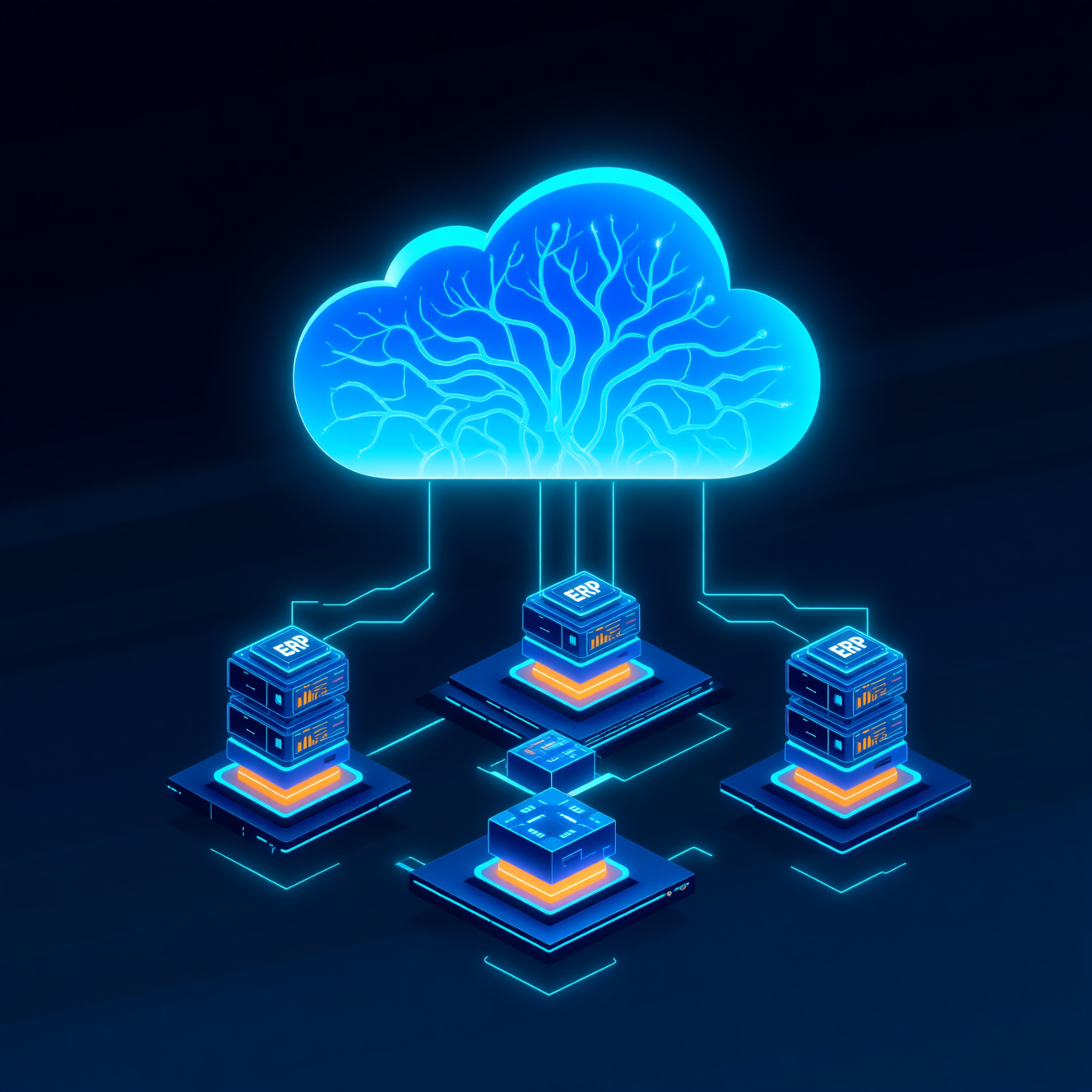
Enterprise resource planning systems represent the highest-stakes deployment target for AI agents. They touch virtually every business process, contain the most sensitive operational data, and any autonomous error can cascade across accounting, supply chain, procurement, and human resources functions simultaneously.
Given that Gartner predicts 40% of enterprise applications will feature task-specific AI agents by 2026, organizations cannot avoid deploying them into ERP environments. The question is how to do it safely.
The agentic transformation within modern ERP represents a fundamental redefinition of the system's role - moving from insight generation toward decision execution. Leading enterprises are deploying AI agents that automate financial close processes, dynamically adjust supply chains to real-time conditions, and guide workforce planning through predictive intelligence.
Every one of these autonomous capabilities requires governance infrastructure that was never designed for probabilistic systems operating on deterministic business logic. Organizations attempting to retroactively apply legacy ERP controls to new agent workflows consistently encounter these failures:
- Authentication mismatch: Traditional ERP access controls map human roles to permission sets with clear hierarchies. Agent systems require equally granular tool-level authorization that operates independently of human role boundaries.
- Data consistency guarantees: ERP databases maintain strict transactional consistency across multiple business units. Autonomous agents modifying these databases through natural language interfaces introduce unpredictable variation into processes designed for deterministic, auditable operations only.
- Audit continuity between legacy workflows and agent actions: When ERP systems generate their own automated transactions alongside agent-driven ones, audit teams require unified log structures that distinguish human-initiated from autonomous actions while providing end-to-end traceability across hybrid execution paths.
Practical Steps for Implementing Agent Governance
The agencies and consulting teams implementing agent governance across Canadian enterprises recommend the following phased approach that balances risk mitigation against innovation velocity:
- Classify agents by operational impact before any deployment: Create a risk matrix evaluating financial exposure, data sensitivity, customer interaction scope, and regulatory relevance. High-impact agents require full three-layer governance from initial production release.
- Start with read-only agent deployments: Deploy agents in monitoring mode that generates recommendations without autonomous execution authority. This produces measurable value through better decision support while simultaneously gathering the operational telemetry required to establish accurate behavioral baselines for policy enforcement layers.
- Implement policy-as-code early: Writing governance rules as configurable code rather than embedded model instructions enables independent review, version control, rollback capability, and audit documentation without requiring engineering changes to the agents themselves. Policy validation should occur at each workflow step with explicit denials when thresholds or constraints are violated.
- Build continuous evaluation loops: Agents deployed in production must be continuously evaluated against defined quality metrics including response accuracy, tool selection appropriateness, policy compliance rate, and cost efficiency. Automated scoring systems flagging agents that drift from acceptable parameter ranges accelerate remediation cycles dramatically.
- Design escalation handoff protocols: Agent workflows must include clearly defined escalation criteria and smooth transition mechanisms between autonomous execution and human operator intervention. The handoff protocol should preserve conversation context, present prior decisions with supporting rationale, and offer recommended recovery paths.
The Governance Maturity Curve: From Reactive to Proactive AI Operations
Organizations progress through identifiable governance maturity stages as they scale enterprise AI agent deployments:
- Stage One - Ad-Hoc Controls: Organizations deploy agents with minimal guardrails, relying on model system prompts alone for behavioral guidance. This produces rapid experimentation at high failure rates during production workflows.
- Stage Two - Manual Review Gates: Organizations insert human approval steps for agent outputs before execution. While this reduces errors significantly it also eliminates the efficiency advantages of autonomous decision-making entirely through throughput bottlenecks and increased latency across critical business processes.
- Stage Three - Policy-Enforced Automation: Governance rules operate as machine-checkable constraints integrated directly into agent workflows. Agents execute autonomously within well-defined boundaries with full observability, audit traceability, and real-time anomaly detection functioning simultaneously without slowing decision velocity.
- Stage Four - Self-Governing Systems: Top-performing enterprises develop governance frameworks capable of evaluating their own policy effectiveness, automatically refining behavioral constraints based on operational telemetry, and adapting to new risk vectors as business requirements evolve. These systems require significant investment in both infrastructure capability and organizational expertise but deliver compounding value through continuously improving autonomy.
What This Means for Canadian Enterprises
Canadian organizations face the same pressures driving global adoption of enterprise AI agents but must navigate additional considerations including cross-border data sovereignty requirements, multi-jurisdictional regulatory expectations, and a talent market where skilled AI engineering resources are genuinely competitive.
Conclusion
The trajectory is clear: enterprise AI agents will become mainstream infrastructure by 2026 regardless of whether organizations are ready. The decision that determines competitive outcomes is no longer whether to adopt agentic systems - it is whether to build governance frameworks strong enough to make those agents reliable, safe, and operationally valuable at enterprise scale.
Evaluating autonomous capabilities within ERP environments through the lens of structured governance transforms what most organizations experience as unpredictable and risky into a competitive advantage measured in faster cycle times, fewer errors, and stronger audit readiness.
The consulting teams delivering this work confirm that every organization achieving production-scale agent automation shares one characteristic: they built governance infrastructure before they built agents. Building an enterprise that is purpose-built for autonomous agents requires establishing robust governance frameworks from day one - establishing policy enforcement at the architectural layer, implementing comprehensive behavioral observability, and designing complete audit trails that satisfy both internal compliance teams and external regulatory expectations simultaneously.
Organizations that master this integration position themselves to capture genuine competitive advantage through reliable, scalable, governable AI automation while those that delay face mounting technical debt, compliance exposure, and the costly cycle of abandoned pilot projects.