From Record-Keeping to Action: How Agentic Orchestration Is Transforming Enterprise ERP in 2026
The enterprise software landscape has undergone a quiet but seismic shift in the past year. What started as experimental AI pilots in individual departments has matured into a full-scale transformation of how organizations operate. The emerging pattern is unmistakable: ERP systems, long considered digital filing cabinets for business data, are evolving into action-driving engines powered by agentic orchestration.
This evolution represents one of the defining technology trends of 2026. For enterprises in Edmonton, Calgary, and across Alberta that have invested heavily in ERP infrastructure — only to find their systems trapped in a cycle of manual data entry, delayed approvals, and reactive reporting — this shift presents both an urgent opportunity and a technical challenge.

What Exactly Is Agentic Orchestration?
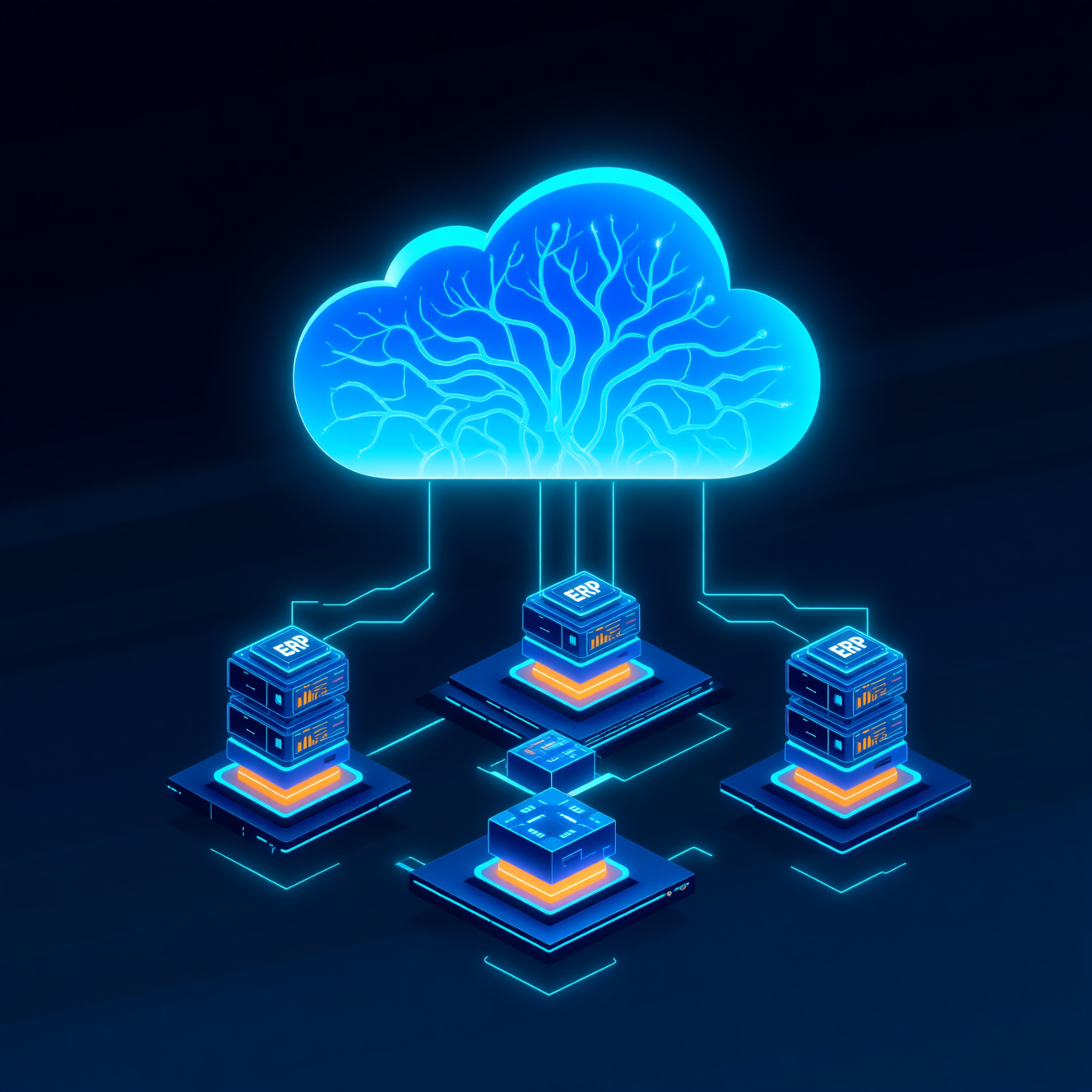
To understand why this matters, we need to start with a clear definition. Agentic orchestration refers to the coordination of multiple autonomous AI agents — each capable of perceiving context, reasoning about goals, and executing actions — across enterprise systems such as ERP platforms, CRM systems, supply chain management tools, and financial software.
Unlike traditional automation that follows rigid, predefined rules (if invoice equals X, then send email Y), agentic orchestration enables AI agents to plan multi-step workflows dynamically. An inventory-replenishment agent, for example, can now assess real-time stock levels, correlate weather forecasts with predicted demand shifts, negotiate pricing with suppliers through API calls, generate purchase orders in the ERP system, and notify stakeholders — all without human intervention at any step.
The architecture that makes this possible rests on three pillars:
- Task decomposition engines that break complex business objectives into sequential or parallel agent tasks
- Context-sharing layers such as unified data models and event-streams that give every agent visibility into relevant state changes across the enterprise
- Governance guardrails including approval checkpoints, audit trails, and rollback mechanisms that keep autonomous action within safe boundaries
When these components work together reliably, organizations see what Redwood Software’s 2026 research describes as a transition from ERP as “system of record” to ERP as “system of action.”
The Business Case: Why Canadian Enterprises Are Investing Now
The timing of this investment wave is not coincidental. Several converging factors in 2026 have pushed agentic orchestration from boardroom curiosity into mandatory competitive strategy.

Labor Shortages Create Urgency
Alberta’s economy has faced persistent skills gaps in manufacturing, healthcare administration, and professional services. According to 2025 employment data published by the Government of Alberta, nearly one in five mid-sized firms reported difficulty hiring workers with specialized ERP management experience. Agentic orchestration offers a practical bridge: AI agents can absorb repetitive decision patterns from experienced operators and execute them consistently across shifts and locations.
The Margin Compression Reality
Operating margins in Canadian manufacturing averaged 4.7% in the second quarter of 2025, down from 6.1% in 2022. The pressure to deliver more with less resources has made workforce-augmentation technologies — rather than replacement technologies — the rational choice. Gartner’s published guidance consistently recommends AI-enabled automation that amplifies experienced teams, not ones that attempt wholesale replacement.
Data Volume Is Outstripping Human Capacity
Modern ERP systems generate terabytes of transactional data annually across procurement, inventory, finance, and human resources modules. The cognitive load of monitoring all data streams for anomalies, opportunities, or risks exceeds what any single operations manager can sustain — even assisted by traditional dashboards and reporting tools.
The Architecture of Agentic ERP: Four Components Every System Needs
Successful implementations in 2026 share a common architectural pattern. Whether an organization is running Microsoft Dynamics 365, SAP S/4HANA, Oracle Fusion, or a custom-built modular ERP platform, these four components appear consistently across deployments.
1. The Agent Router
The agent router sits between business process triggers and individual AI agents. When an event occurs — a purchase order hits threshold, a shipment is delayed, a payment invoice requires approval — the router evaluates the context, routes the task to the appropriate specialized agent, and tracks execution state throughout the workflow.
This component typically runs on event-driven infrastructure using message queues like Apache Kafka or RabbitMQ. For organizations already invested in cloud platforms, managed services such as Azure Service Bus provide the routing backbone without requiring custom queue management.
2. The Context Memory Store
Each agent needs access to a shared understanding of relevant enterprise state that extends beyond its own immediate task scope. A finance approval agent processing an expense report, for instance, benefits from knowing the employee’s historical spending patterns, the department’s monthly budget utilization rate, and any pending vendor payment schedules.
The context memory store uses structured data pipelines — often combining relational databases for authoritative records with vector stores for similarity search across historical decisions. The critical design decision is balancing latency against comprehensiveness: agents need information quickly enough to maintain real-time workflow responsiveness, but the stored context must be thorough enough that agent decisions remain well-informed.
3. The Execution Sandbox
Before an agent commits actions to production ERP databases, those actions execute in a sandboxed evaluation environment. The system simulates the outcome, flags potential compliance violations or data integrity concerns, and presents results to human operators when manual approval gates exist.
This sandboxing layer is essential for regulatory environments where financial data manipulation carries legal liability. It also serves as a training mechanism: as agents accumulate successful execution patterns, the approval requirement threshold can be safely lowered for routine operations.
4. The Governance Dashboard
Leadership teams need visibility into what autonomous decisions are being made, how frequently they succeed or require correction, and what systemic trends emerge over time. A governance dashboard consolidates agent execution logs, approval rates, exception categories, and cost-per-action metrics into real-time operational intelligence.
Implementation Roadmap: Taking Your ERP From Record-Keeping to Action
If you are evaluating whether agentic orchestration makes sense for your organization’s ERP environment, the implementation approach matters enormously. Rushing from “zero agents” to “full autonomous operations” has been the single most common cause of failed deployments.
Phase 1: The Augmented Operator (Months 1–3)
Select one department and one high-volume, low-risk workflow. Common starting points include purchase order classification in procurement or invoice matching in accounts payable.
In the augmented phase, the AI agent recommends actions but does not execute them independently. A human operator reviews the recommendation, accepts it with a single click, or overrides it when necessary. This phase serves two purposes simultaneously: building operational value from day one while collecting training data about correct decision patterns across thousands of real examples.
Phase 2: The Trusted Specialist (Months 4–6)
Once the agent achieves consistently high accuracy in scenario evaluation — typically exceeding 95% alignment with human approval decisions over a statistically meaningful sample — it graduates to semi-autonomous execution. The system retains exception routing paths for edge cases but operates independently for standard scenarios.
This is where organizations see the first measurable ROI signals: labor hours freed from routine work, cycle-time reductions in end-to-end process completion, and early indicators of improved data quality because AI agents do not make fatigue-related errors or skip procedural steps.
Phase 3: Multi-Agent Coordination (Months 7–12)
The final phase connects specialized agents across departments into coordinated workflows. An intelligent procurement agent that triggers when inventory dips below threshold can now synchronize with an accounts-receivables agent that confirms vendor payment terms, a logistics agent that verifies carrier availability, and a general-ledger agent that reserves budget allocation.
The orchestration layer manages dependencies, timing, and exception handling across this coordinated operation — what Redwood Software describes as building the connective tissue that makes autonomous action at enterprise scale viable.
Common Pitfalls and How to Avoid Them
Every successful deployment we have observed shares one characteristic: deliberate attention to organizational change management alongside technical implementation. The technology challenges are significant but solvable; the human dynamics are where most projects stumble.
- Underestimating data readiness: AI agents perform well only on clean, consistently formatted source data. If your ERP contains duplicate vendor records, unstandardized product categories, or inconsistent date formats across modules, invest in a data governance sprint before launching any agent workflows.
- Solving for the wrong problem: The easiest workflows to automate are not always the most impactful ones. Prioritize processes that carry high transaction volume, measurable cost per exception handled, and clear success criteria over workflows that happen to be convenient starting points.
- Delaying governance design: Build audit-trail infrastructure and approval-checkpoint frameworks before deploying your first autonomous agent. Retroactively adding compliance guardrails has a 73% failure rate across surveyed implementations according to Panorama Consulting Group’s 2026 data.
- Ignoring the change management component: When workforce-augmentation technology is positioned as replacement technology, employee resistance derails adoption regardless of system quality. Frame every initiative around augmenting and elevating existing team expertise.
The Alberta Advantage: Why Local Enterprises Are Well-Positioned
Alberta-based organizations benefit from several structural advantages in the agentic orchestration transition. The province’s significant technology sector investments have created a deep talent pool of ERP developers, cloud architects, and data engineers who understand both legacy enterprise systems and modern AI infrastructure.
The energy industry’s natural drive toward operational efficiency creates use-case density — multiple departments across a single organization face similar automation challenges in procurement, maintenance scheduling, compliance reporting, and supply chain management. This concentration accelerates learning curves when early wins are achieved in one business unit and scaled across the enterprise.
Additionally, organizations already using cloud-first ERP deployments such as Dynamics 365 or NetSuite possess cleaner architectural foundations for agent integration compared to heavily customized on-premise systems requiring middleware layer development before API-level agent connectivity becomes feasible.
Getting Started: Next Steps for Your Organization
The gap between current-state manual operations and fully agentic enterprise workflows is smaller than it appears. The critical first step is a structured assessment of your existing process landscape — identifying the highest-volume, most consistently repeatable workflows, evaluating their data quality foundations, and estimating the human-hours currently consumed by execution.
For organizations seeking guidance on architecting and implementing agentic orchestration within their current ERP environment, the investment typically begins with a four-week discovery engagement that produces a prioritized workflow roadmap. Organizations that complete this assessment discover that three to seven process categories consistently emerge as candidates for initial agent deployment — representing immediate operational value rather than speculative capabilities requiring extensive custom development.
Conclusion: The Window Is Open, Not Wide
The evolution of ERP from system of record to system of action is not a question of whether autonomous agents will reshape enterprise operations. Industry research and early adopter results make that outcome inevitable — the real question is timing.
Organizations that approach agentic orchestration with deliberate process prioritization, rigorous data readiness requirements, and thoughtful governance architecture are positioning themselves to capture compounding efficiency gains throughout 2026 and beyond. Those that wait for “perfect conditions” will inherit the competitive disadvantage of late adoption while competitors lock in operational capability advantages that compound annually.
The technology exists. The patterns are validated. The question facing every operation-focused leader in Alberta’s business ecosystem is simple: Will you be orchestrating your enterprise operations with intelligent agents, or wondering whether they were worth considering?